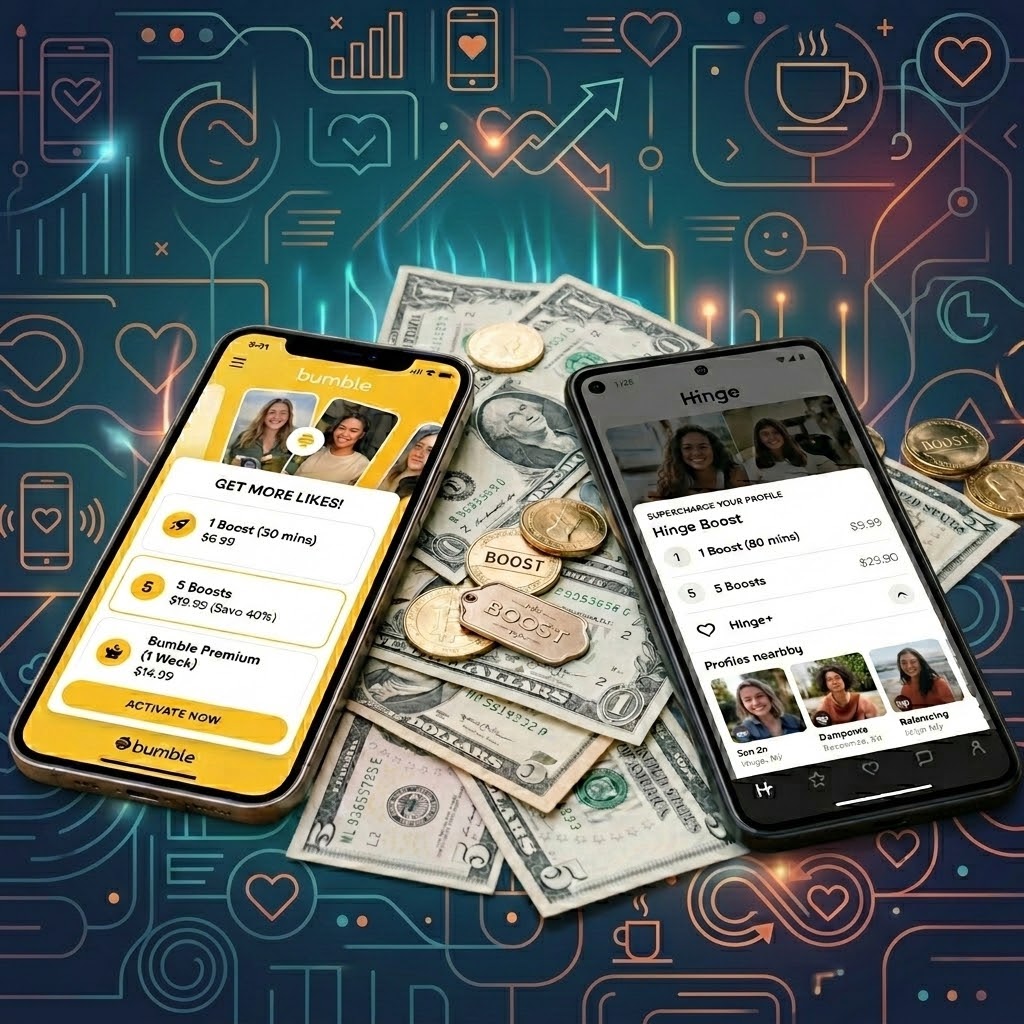
The Truth About Paid Features on Tinder, Bumble, and Hinge
Open almost any dating app today and you’ll encounter the same offer:
Boost your profile.
Get more visibility.
Get more matches.
Stand out from the crowd.
Whether it’s a Boost on Tinder, a Spotlight on Bumble, or a Boost on Hinge, dating apps increasingly encourage users to pay for additional exposure. The promise is simple: spend a few dollars and more people will see your profile.
But do these paid features actually work?
The answer is both yes and no.
The real question isn’t whether boosters increase visibility. Most of them do.
The question is whether increased visibility translates into better outcomes.
How Dating App Boosters Work
Although each platform uses its own terminology, the concept is largely the same.
Tinder Boost
Tinder’s Boost temporarily places your profile near the front of the discovery queue in your area.
The idea is straightforward:
More people see your profile in a shorter period of time.
Bumble Spotlight
Bumble’s Spotlight feature serves a similar purpose.
Users receive increased exposure for a limited time, allowing their profile to be viewed by more potential matches.
Hinge Boost
Hinge Boost works by increasing profile visibility during selected periods.
Like its competitors, the goal is to maximize impressions and increase the likelihood of receiving likes and matches.
On paper, these features seem highly effective.
More visibility should create more opportunities.
But reality is more complicated.
The Visibility Problem
Many users assume their lack of matches is caused by low visibility.
Sometimes that’s true.
However, visibility is only one part of the equation.
Bumble says Spotlight pushes your profile to more users for 30 minutes and increases visibility. However, Bumble does not publicly publish percentages for additional matches or dates
A journalist testing Hinge’s paid Boost generated 23 new likes after a one-hour boost, although some of those likes may have already been pending. The Guardian
A boost can increase profile views dramatically, but it cannot fix:
- Poor photos
- Weak bios
- Unclear intentions
- Lack of effort
- Incompatible targeting
Imagine placing a poorly designed advertisement in Times Square.
Millions of people may see it.
That doesn’t guarantee anyone will buy the product.
Dating profiles work the same way.
A boost amplifies what already exists.
If the profile performs well, results often improve.
If the profile performs poorly, the boost simply exposes more people to the same weaknesses.
Why Some Users See Great Results
There are plenty of success stories.
Users frequently report:
- More profile views
- More likes
- More matches
- Faster conversations
This makes sense.
The apps are generally delivering what they promise: visibility.
For users with strong profiles, boosters can act like fuel on an already burning fire.
The additional exposure helps them reach more compatible people.
In those situations, paid features often provide measurable value.
Why Others Feel Disappointed
The disappointment occurs when users mistake visibility for compatibility.
Receiving twenty additional matches does not necessarily mean receiving twenty meaningful opportunities.
Many boosted users report:
- Lower-quality matches
- Short conversations
- More ghosting
- Little change in actual dates
The number that matters most is not matches.
It is connections.
A boost can improve the first metric without affecting the second.
The Hidden Difference Between Free and Paid Platforms
One of the most interesting questions in online dating is why paid visibility often appears to perform better on some smaller or subscription-based platforms than on large free apps.
The answer lies in competition.
The Attention Economy
Free dating apps operate at enormous scale.
Millions of users compete for attention simultaneously.
This creates a crowded marketplace.
When thousands of users are boosting their profiles, purchasing premium subscriptions, and optimizing visibility, the advantage of any single booster becomes diluted.
Everyone is trying to move to the front of the line.
As a result, visibility becomes increasingly expensive and less differentiated.
Why Boosters Often Work Better on Smaller Platforms
Smaller or subscription-based dating platforms typically have fewer users competing for attention.
This creates several advantages:
Less Competition
A boosted profile stands out more when there are fewer profiles fighting for visibility.
Higher User Intent
Users who pay for membership often have stronger motivations to engage and respond.
This can lead to higher-quality conversations.
Lower Noise
Platforms with fewer fake accounts, inactive profiles, and casual browsers often create a cleaner experience.
The same visibility increase can therefore produce better outcomes.
More Meaningful Exposure
On a smaller platform, being seen by 100 highly engaged users may be more valuable than being seen by 1,000 disengaged users.
Quality often outweighs quantity.
The Real Question Users Should Ask
Instead of asking:
“Will this boost get me more matches?”
Users should ask:
“Will this boost get me better opportunities?”
The distinction matters.
A successful dating experience is not measured by impressions, likes, or even matches.
It is measured by conversations, dates, and relationships.
The Future of Paid Dating Features
The challenge facing dating apps is that users are becoming increasingly sophisticated.
Many no longer judge platforms solely on match volume.
They care about outcomes.
This is one reason why the industry is experimenting with:
- Video dating
- Speed dating
- Group experiences
- Real-world events
- AI-assisted matching
The focus is gradually shifting from maximizing visibility to improving connection quality.
Boosters will likely remain part of the dating ecosystem.
But their value may increasingly depend on what happens after the match rather than before it.